Private Well Water Treatment Architecture: 3-Stage Pre-Filtration for Iron & Arsenic
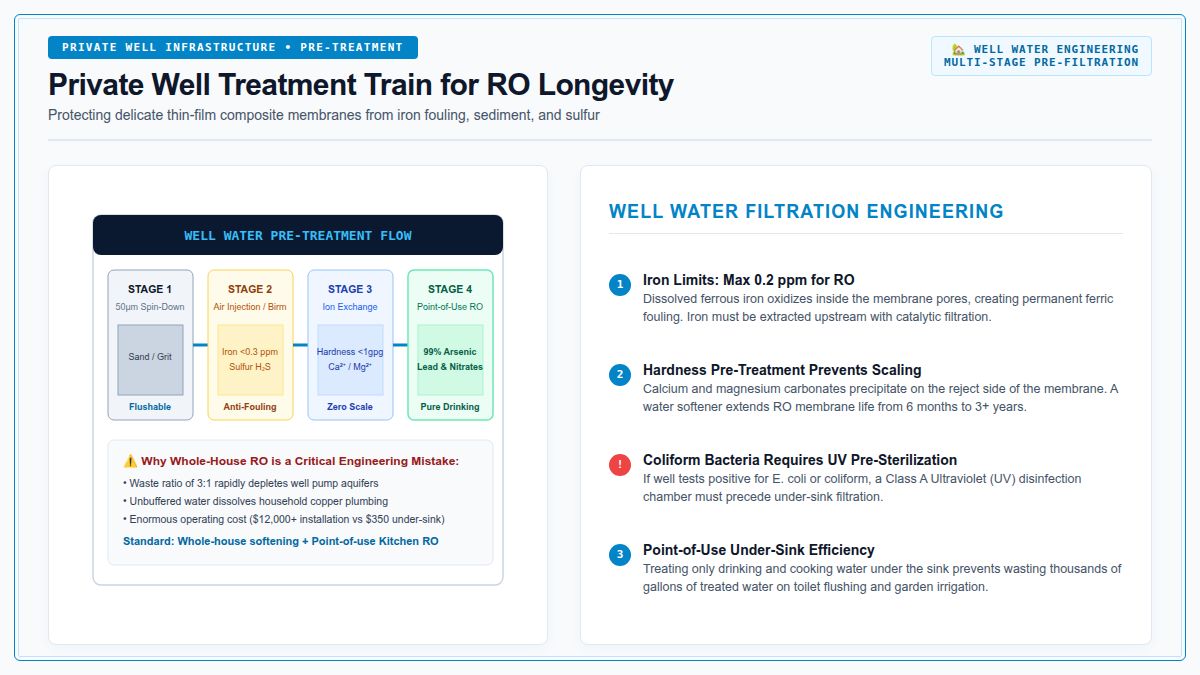
Installing a reverse osmosis system directly onto raw well water without upstream pre-treatment is an expensive failure. Dissolved ferrous iron, manganese, and calcium hardness will irreversibly coat and blind the polyamide membrane within weeks. A disciplined 3-stage pre-treatment train preserves membrane lifespan from 3 months to over 3 years while delivering certified pure drinking water.
1. The Three Membrane Killers in Groundwater
Unlike treated municipal supplies, private deep wells draw from geological aquifers laden with raw mineral compounds:
- Ferrous Iron (Fe²⁺): Invisible and clear in fresh well water. However, when pressurized against the membrane in the presence of trace oxygen, it oxidizes into insoluble ferric iron (Fe³⁺), precipitating an unremovable rusty crust directly over the microscopic pores. Iron must be strictly below 0.2 ppm before entering an RO system.
- Calcium Carbonate Scale: As pure water permeates through the membrane, the remaining brine stream becomes super-saturated with hardness ions. Without an upstream ion-exchange water softener, calcium scale precipitates onto the feed channels.
- Abrasive Silicate Sand: Microscopic sand grains from the well casing scour the delicate polyamide barrier, causing irreversible physical tears that destroy filtration rejection.
2. The Standard Well Treatment Train
To protect both your home plumbing and your under-sink drinking RO unit, the following sequential layout is the recognized American environmental engineering standard:
- Point-of-Entry 50-Micron Spin-Down Filter: Traps heavy coarse sand and sediment before it enters household valves; easily flushed via bottom ball valve.
- Air Injection Oxidizing (AIO) Filter: Uses catalytic media (Katalox Light or Birm) to oxidize dissolved iron and hydrogen sulfide (rotten egg odor) into solid particles, backwashing them automatically to drain.
- Whole-House Ion-Exchange Water Softener: Strips calcium and magnesium down to < 1 grain per gallon (gpg), ensuring zero scale formation on water heaters and RO membranes.
- Point-of-Use Under-Sink 5-Stage Reverse Osmosis: Delivers the final molecular polish, removing dissolved Arsenic-V, Lead, Nitrates, and PFAS from cooking and drinking water.
Reverse Osmosis vs. Activated Carbon: Why Carbon Fails on Lead, Fluoride & PFAS
TDS Membrane Rejection Efficiency & Filter Lifespan Specifier
Measure your membrane's physical rejection efficiency using raw feed TDS versus pure permeate TDS. Real-time diagnostics calculate exact membrane health, pore integrity, and scheduled filter cartridge replacements.